 Add to Chrome
 Add to Firefox
 Add to Edge
OxygenREC: An Instruction-Following Generative Framework for E-commerce Recommendation
Dec 31, 2025
Traditional recommendation systems suffer from inconsistency in multi-stage optimization objectives. Generative Recommendation (GR) mitigates them through an end-to-end framework; however, existing methods still rely on matching mechanisms based on inductive patterns. Although responsive, they lack the ability to uncover complex user intents that require deductive reasoning based on world knowledge. Meanwhile, LLMs show strong deep reasoning capabilities, but their latency and computational costs remain challenging for industrial applications. More critically, there are performance bottlenecks in multi-scenario scalability: as shown in Figure 1, existing solutions require independent training and deployment for each scenario, leading to low resource utilization and high maintenance costs-a challenge unaddressed in GR literature. To address these, we present OxygenREC, an industrial recommendation system that leverages Fast-Slow Thinking to deliver deep reasoning with strict latency and multi-scenario requirements of real-world environments. First, we adopt a Fast-Slow Thinking architecture. Slow thinking uses a near-line LLM pipeline to synthesize Contextual Reasoning Instructions, while fast thinking employs a high-efficiency encoder-decoder backbone for real-time generation. Second, to ensure reasoning instructions effectively enhance recommendation generation, we introduce a semantic alignment mechanism with Instruction-Guided Retrieval (IGR) to filter intent-relevant historical behaviors and use a Query-to-Item (Q2I) loss for instruction-item consistency. Finally, to resolve multi-scenario scalability, we transform scenario information into controllable instructions, using unified reward mapping and Soft Adaptive Group Clip Policy Optimization (SA-GCPO) to align policies with diverse business objectives, realizing a train-once-deploy-everywhere paradigm.

Adaptive Control of Client Selection and Gradient Compression for Efficient Federated Learning
Dec 19, 2022


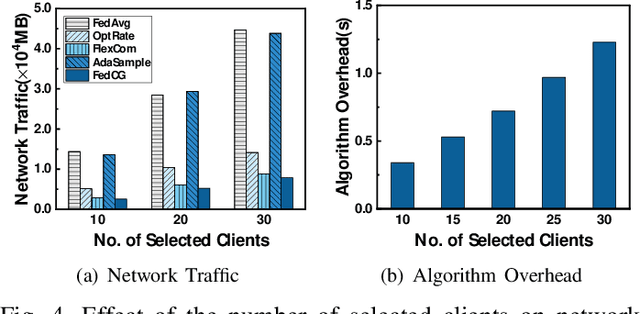
Federated learning (FL) allows multiple clients cooperatively train models without disclosing local data. However, the existing works fail to address all these practical concerns in FL: limited communication resources, dynamic network conditions and heterogeneous client properties, which slow down the convergence of FL. To tackle the above challenges, we propose a heterogeneity-aware FL framework, called FedCG, with adaptive client selection and gradient compression. Specifically, the parameter server (PS) selects a representative client subset considering statistical heterogeneity and sends the global model to them. After local training, these selected clients upload compressed model updates matching their capabilities to the PS for aggregation, which significantly alleviates the communication load and mitigates the straggler effect. We theoretically analyze the impact of both client selection and gradient compression on convergence performance. Guided by the derived convergence rate, we develop an iteration-based algorithm to jointly optimize client selection and compression ratio decision using submodular maximization and linear programming. Extensive experiments on both real-world prototypes and simulations show that FedCG can provide up to 5.3$\times$ speedup compared to other methods.